
Gender Equality Plan (GEP) 2026–2029
GreenChem Club, Bayelsa
PURPOSE AND SCOPE
This Gender Equality Plan (GEP) establishes a formal framework to ensure that GreenChem Club, Bayelsa remains an inclusive, diverse, and equitable organization. As an entity engaged in scientific research, environmental advocacy, and virtual knowledge exchange in the Niger Delta, we recognize that gender equality is essential for high-quality research, sustainable community impact, and effective international collaboration.
2. MANDATORY PROCESS REQUIREMENTS
2.1 Dedicated Resources
The Club commits the following resources:
Gender Equality Unit: A subcommittee led by the Program Anchors and a designated Gender Officer.
Budget: 15% of all project overheads/grants is allocated to gender-mainstreaming activities.
Expertise: CVs of the leadership team (Prof. Abosede, Kelechi Peace Kanu, and Victory Emegbue) reflect extensive experience in managing diverse academic and community-based teams.
2.2 Data Collection and Monitoring
We collect and analyze sex-disaggregated data annually to track:
Gender ratios in membership and executive leadership.
Participation of women in field-based environmental monitoring.
Female authorship rates and integration of gender analysis in scientific publications.
Participation patterns in virtual exchange activities and online collaboration platforms.
2.3 Integration into Decision-Making Processes
Gender equality considerations are integrated into all organizational decision-making:
Executive Review: The Gender Officer presents annual sex-disaggregated data to the Executive Committee with recommendations for corrective actions.
Research Design: All research proposals must include a gender impact assessment reviewed by the Gender Equality Unit before approval.
Recruitment & Selection: Gender balance is a weighted criterion (minimum 20%) in all selection panels for research stipends, leadership roles, and international exchange opportunities.
2.4 Training and Capacity Building
Mandatory training sessions on Unconscious Gender Bias and Gender-Sensitive Research are conducted for all decision-makers and student members. (See Appendix A for the curriculum).
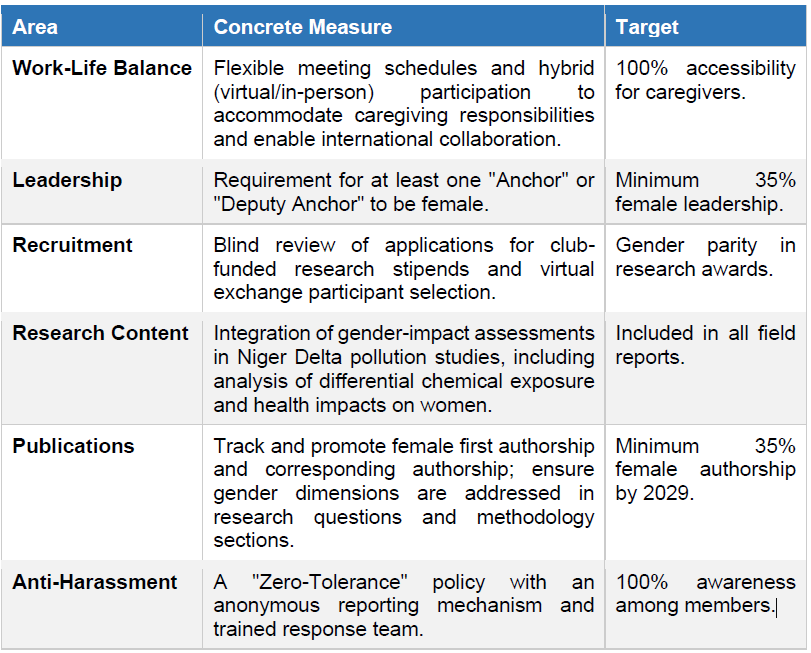
3. THEMATIC AREAS AND TARGETS
4. IMPLEMENTATION ROADMAP (2026–2029)
Year 1 (2026): Foundation
• Establish Gender Equality Unit and appoint Gender Officer (Q1).
• Conduct baseline data collection on all metrics (Q2).
• Deliver first Unconscious Bias training to all leadership and decision-makers (Q3).
Year 2 (2027): Integration
• First annual review of sex-disaggregated data with corrective action plan (Q1).
• Implement blind review process for all research stipends and awards (Q2).
• Launch virtual exchange program with explicit gender inclusion targets (Q3).
Year 3 (2028): Consolidation
• Mid-term GEP review and adjustment based on achieved outcomes (Q2).
• Second biennial Unconscious Bias training cycle (Q3).
• Publication of first gender-disaggregated impact report (Q4).
Year 4 (2029): Evaluation & Planning
• Final assessment of 2026–2029 GEP targets (Q2–Q3).
• External evaluation by independent gender equality expert (Q3).
• Development of GEP 2030–2033 informed by lessons learned (Q4).
5. MONITORING AND ACCOUNTABILITY
Annual Review Process:
1. Data Analysis: Gender Officer compiles sex-disaggregated data across all thematic areas (January annually).
2. Executive Review: Presentation to Executive Committee with gap analysis and recommendations (February).
3. Corrective Action: If any target shows less than 70% achievement, a mandatory corrective action plan must be developed within 30 days.
4. Public Reporting: Annual gender equality progress report published on club website (March) and/or social media platforms.
Accountability Mechanisms:
• The Gender Officer reports directly to the Lead Advisor and has authority to flag non-compliance issues.
• Gender balance is a mandatory evaluation criterion for all project proposals and funding applications.
APPENDIX A: UNCONSCIOUS BIAS TRAINING CURRICULUM
Target Group: Staff, Executive Members, and Decision-Makers.
Frequency: Biennial (Every 2 years).
Module 1: Understanding Unconscious Bias
• Defining "Implicit Bias" vs. "Explicit Prejudice."
• The science of heuristics: How the brain categorizes people in STEM.
• Activity: The Implicit Association Test (IAT) for gender and science.
Module 2: Bias in the Research Lifecycle
• Addressing the "Matilda Effect" (the under-recognition of female scientists).
• Correcting gender bias in peer review and laboratory task allocation.
• Integrating the gender dimension in Green Chemistry (e.g., specific chemical toxicity levels in women).
Module 3: Mitigation Strategies for Decision-Makers
• Implementing "Structured Interviews" for club recruitment.
• The "Pause and Reflect" technique during executive appointments.
• Establishing "Gender-Neutral" language in official communications.
Module 4: Safety and Field Advocacy
• Identifying and preventing micro-aggressions during field research in rural Bayelsa.
• Bystander intervention training for preventing sexual harassment during community outreach.